Hi all!
As I’m a new user of this forum and this is my first post, let me introduce myself: My name is David and I’m from Barcelona, Spain. Although I’ve never owned an Amstrad computer (my first computer was a Commodore 64), I experienced the 8 and 16-bit computer boom of the 80s and early 90s and some of my friends had a CPC464 (and one of them a CPC6128).
Recently I’ve become interested in retro-programming in BASIC for vintage 8 bit and 16 bit systems, both for learning and for fun. Some months ago I wrote a simple game called “Mega Chase”, and I’ve been writing versions for different computers such as the Commodore 64, the MSX2+, the Amiga (AGA), the Atari ST/E, the Commodore VIC-20, the Commodore Plus/4, or the Mega65 (not a “vintage” system strictly speaking, though). Now I’m developing a version for the Amstrad CPC “plus” series, to take advantage of the expanded colour palette and the hardware sprites.
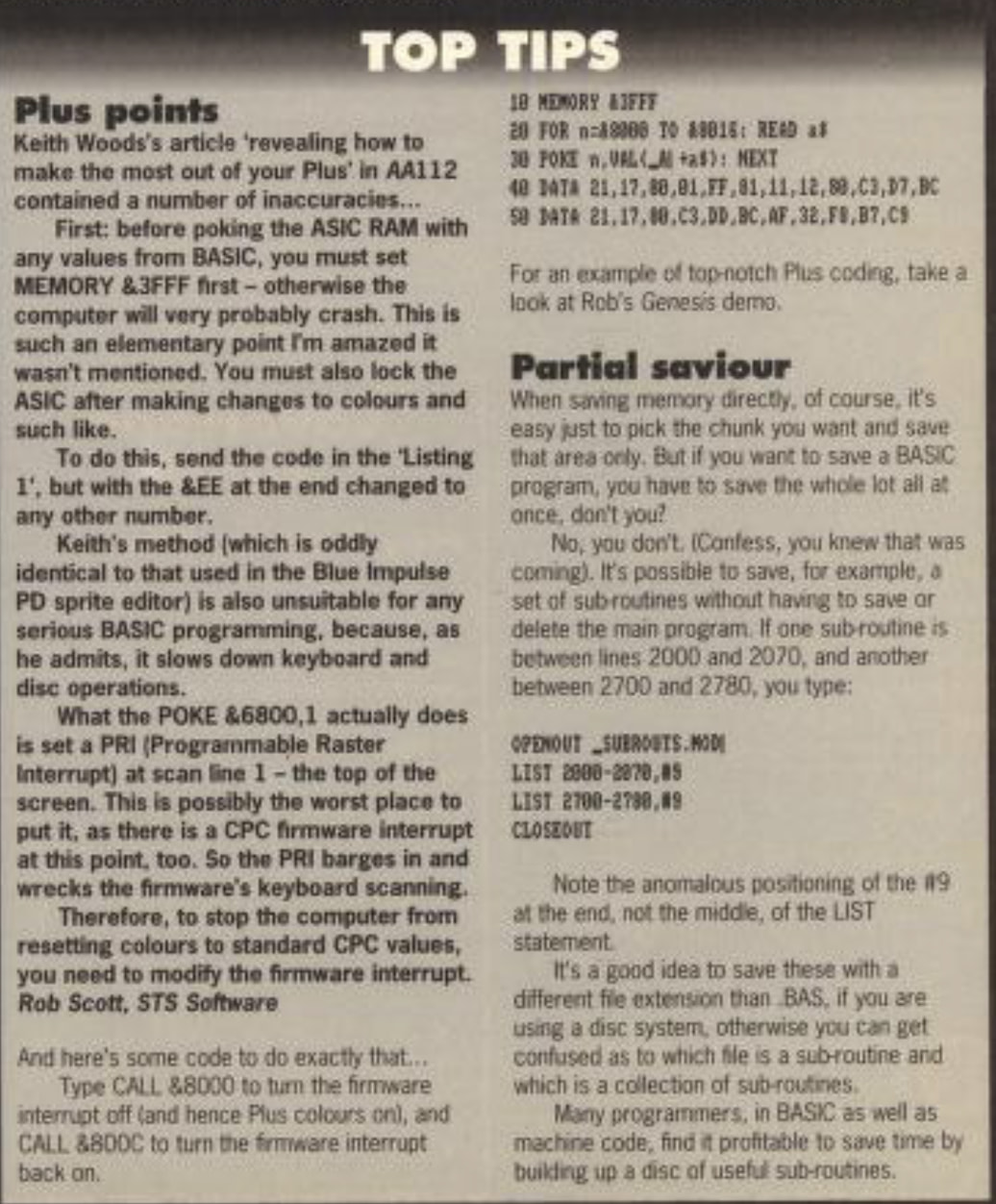
I’m facing a problem, though, when trying to use the 4096 colour palette for the main screen (the specific sprite palette works perfectly). When, for instance, I want to change the border colour (address &6420 and &6421 of the ASIC), the original colour is restored immediately, in the next frame. The results are the same even if I use de “DI” instruction to disable interrupts. It does the same both on WinApe (Windows) and in Amspirit (MacOS).
Is there a way to use the expanded palette from BASIC without the “immediate restoration” effect?
Best,
David (shad0wfax)