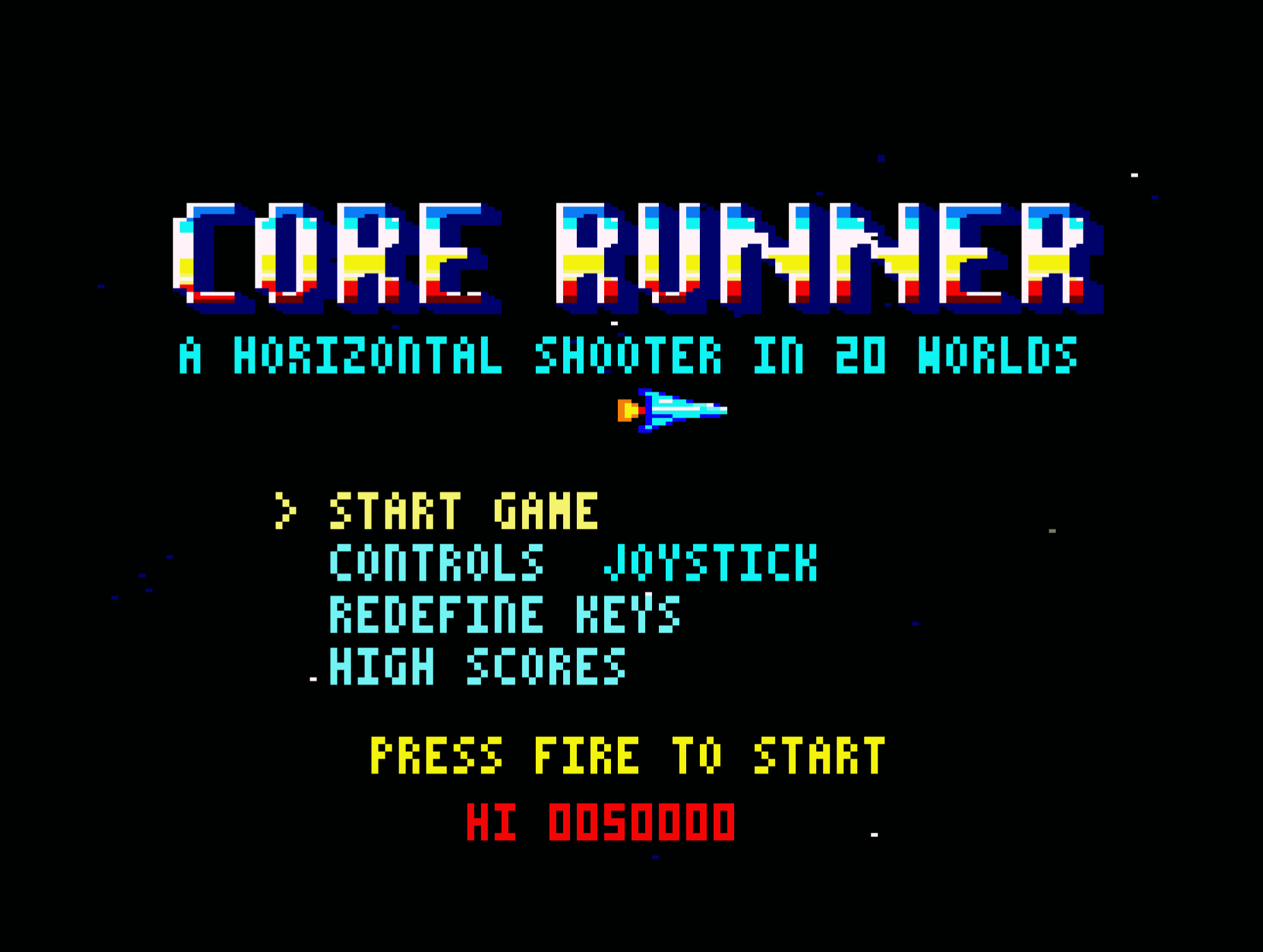
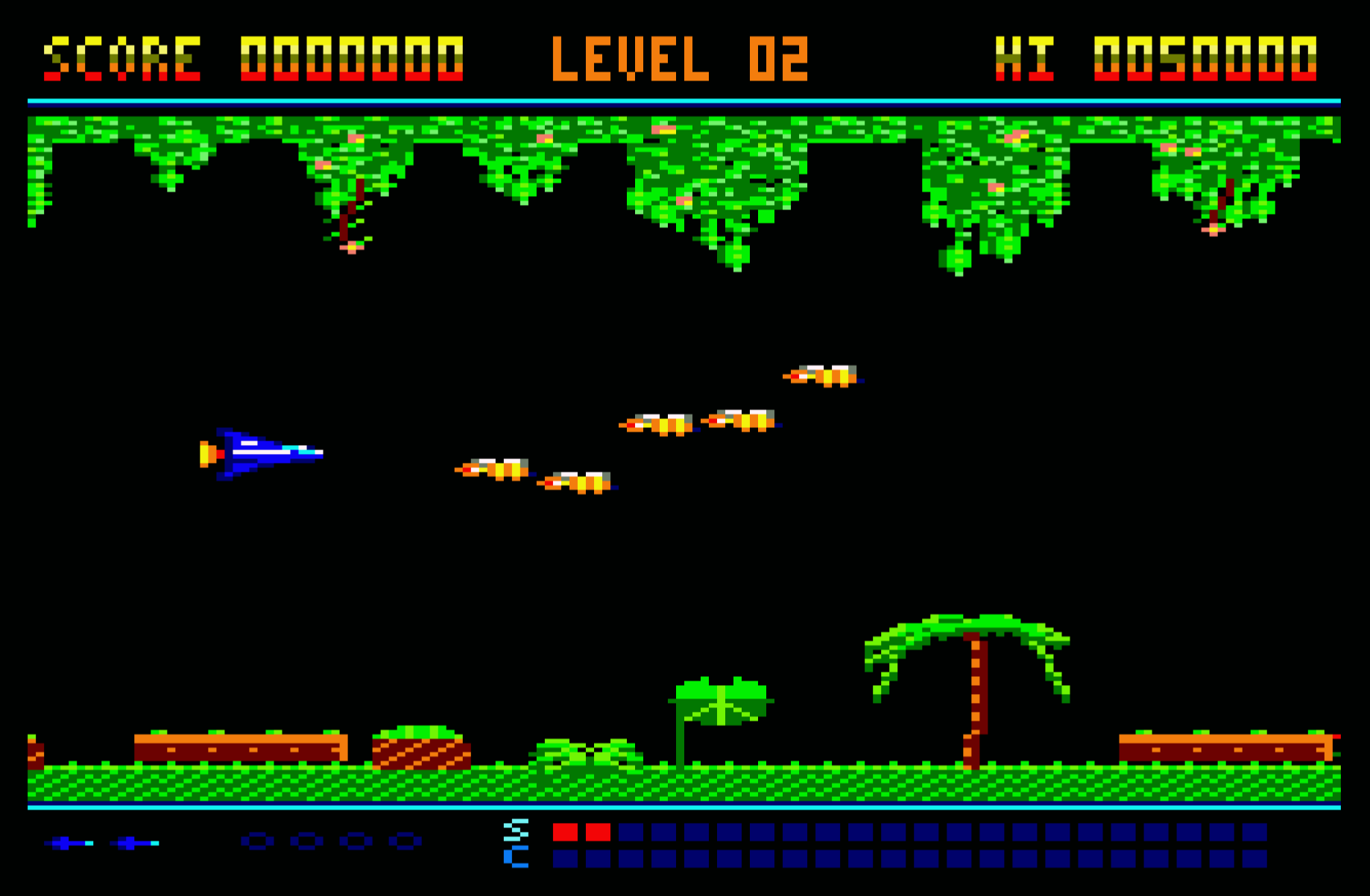
I’m currently trying to program a side-scrolling shooter using the same sprite engine (along with its sprite editor) that I developed for my game “Sternenschwarm”.
In fact, there are two programs running “side-by-side” here: the shooter itself and the background scrolling. Since it uses hardware scrolling, I can’t slow it down without it starting to stutter.
Notes:
TIP: Don’t forget to switch controls to keyboard
So far, I have only implemented 4 of the 20 levels.
I’ve disabled sound again for now. It’s still terrible.
Each level has its own unique design.
High scores are saved, as long as the disk is writable.
The game features “power-ups”
The floppy disk is already almost full, so I’ll probably have to rethink the overall game. I’m also having a really hard time striking the right balance between difficulty and fun this time around. I don’t really have any exciting ideas at the moment, other than more themed worlds.
Hi there. You are popping a new game every other day and there is a certain ‘AI aura’ starting to develop. So, to be frank, how much AI has been used here?
I had ChatGPT provide and explain the code for the hardware scrolling to me. I specifically tailored it to my needs (see the continuous redrawing of the graphics on the right side. That’s 2 new pixel columns per frame (= 1 byte, Mode 0). See also my published sprite editor for this, which supports the required in-memory data layout as an export format).
The note sequence for the background music comes 100% from AI (disabled in the mockup, though, because it’s still dreadful to listen to).
For the player, I use the brilliant ArkosTracker3. It already exists, so I don’t need to write it myself.
The other tools (sound effects, sprite engine, interrupt handler) were written entirely by me. Btw: the interrupt handler and stack management of all objects are written in C, taken from a microcontroller project. It’s always the same everywhere. That’s the beauty of it.
My sprite editor (HTML file, published elsewhere) was created with AI assistance. However, it’s used exclusively for creating graphics. Special feature: it can convert arbitrary images into CPC sprites. It supports a data layout that enables fast sprite drawing.
So how much AI is actually in the mockup? All in all, quite a lot. AI makes a great teacher and builds motivation. That’s how I use it.
Take a look at the little details in the current mockup, like: the plane’s flame moves depending on its own movement. That’s handcrafted. That’s the soul of a program. Does an AI include loving little details? I don’t know…
Also, the graphics get worse from level to level. I lost motivation. An AI would have finished it with a prompt?!
Two sentences about myself:
I’m 59 years old and have a degree in computer science (Diplom-Informatiker).
My motivation is keeping an old hobby alive. I’m now at an age where professional demands are winding down.
Back when CPC magazines were still sold at newsstands, I already had several publications in them about the CPC: games, copier and disk tools… Ever since then, my heart has remained tied to this computer. (Oh, the shock—that’s over 40 years ago!)
There were and still are publications of mine on other forums (pre-COVID; see Asteroids in an earlier version), but unfortunately, those forums have since vanished.
This leads me to the idea: Would anyone be interested in a series of articles here on how to develop software on a CPC using a cross-assembler? An AI can explain that too, though… Hmm… maybe not, then?! There are already YouTube courses as well…
It’s true:
Without AI, this mockup wouldn’t exist.
With more AI, it would look nicer and probably be finished.
There are exactly three or four topics left that interest me. All of my previous mockups and games head in this exact direction:
A game idea inspired by Elite, but with an integrated economic simulation where every decision the player makes has a direct impact on the overall system. It takes place entirely in our solar system (planets and moons).
A game idea modeled after The Bard’s Tale (Part 1). However, featuring a graphics engine that visualizes rotations (like in my first mockup). The puzzles should be so difficult that you need to do real-world research to beat the game.
A game that features continuous diagonal scrolling. Similar to the classic game Zaxxon.
(possibly also a more complex version of the Amiga game Carrier Command. An evolution of my Elite economic simulation. But for now, this one is just in the planning stages on a sheet of paper. I also haven’t decided on the target platform yet. Possibly just for the Raspberry Pi (natively), general Linux, browser game, CPC 6128, depending on what interests me more at that point.)
After that, I’ll turn my attention to other hobbies
See, it’s not that hard. Be brave. Now, with regards to the game.
Have you played it? I literally finished it just by pressing fire, without shifting the ship even one pixel from its starting position. Fun fact, if you have your browser in windowed mode and you start the game with the embedded emulator, you press fire repeatedly until you get all the pickups, then keep the fire button pressed and with your mouse click outside the wiki browser window. You can do whatever task you want on your PC while watching the game completing itself.
So, it does look to me as one case of (and this isnt aimed at this game in particular, but it’s a broader observation) ‘design of the game was left to the AI and the prompter doesn’t have a clue about what’s going on’; or even doesnt care.
The other thing that blows me away (again, broader observation) is the how many people will jump and cheer how great one release is, when it really is so abysmally crap.
(edit: just to clarify, both last sentences are meant to be about AI releases in general, not aimed at this release in particular)
And to be honest, his releases start to change my opinion about the usage of AI in retrogames. They are clearly inspired by classics - but also they are somehow a fresh inspiration with crisp and colourful gfx and not just a blatant 1:1 copy from an arcade original.
Sure, they lack that final polishing that changes the PoC into a fun and great game, but looking at the game, I see the potential for it already. I would LOVE to play that game after the level design was manually adjusted so it becomes an actual challenge.
But yeah, not with that level design as it is. But anyway … I love the scrolling, I love the gFX, I love the general feel of it - and I am surprised to say that about a game where AI played such a crucial role.
It appears that the non-disclosure of the use of AI is a sensitive matter, so I guess this should be taken into account. Then, people can only comment on what is being available to them. I’m not sure what is the point of posting a ‘prototype’ if one isnt aiming at getting feedback.
I published this prototype to get feedback. In whatever form. So far, I consider the discussion to be constructive. I read every piece of feedback. Thank you very much for your thoughts and input.
Well, I make shooters (the graphical part), so I know shooters. And I am very picky when it comes to shooters. What you’ll get from me is the same feedback I’d give my own self.
To be fair, that sort of thing can slip through even in commercial releases. Fire up a game of Bubble Dizzy, start it and then press no control keys whatsoever. You’ll live forever and rack up an enormous score.
Even with proper play testing sometimes doing something entirely unexpected can lead to an issue that the developer never anticipated or expected because they’ve never even considered playing like that.
If much rather see AI used like this, to help build a concept from scratch and augmented with manual development as needed than just slop conversions of existing well known titles. Yes it needs more work and play tests and AI will likely never be able to manage the nuance of good level design, but that’s where a bit of human intervention can make the most benefits.
Things I like: the game itself feels great. There are a lot of tick cases in your shooter:
Good overall speed
lots of different enemies
boss fights
power up
So is there something to report? Of course yes:
Are you invincible in this mockup? I touch a lot of things, I see my ship taking damage, but nothing happens. I suppose up gauge should decrease, right?
Too much power ups… You basically start from one shoot to “wall of fire” too quickly. Keep power up appearing with special identified enemies
Shoots and enemies from ground are hard to see, I think that bullets should be more visible in general
If you charge your fire, don’t fire normal shots (or keep only satellites firing). But make it a cool effect, like a bigger ‘R-Type’ like shot that deals a lot of damage
Boss seems a bit weak, example: second boss should try to lick you by moving a bit more.
I am not that annoyed by the flickering, the pace is good and it forgives a bit this particularity of your engine.
But as a mock up it is a really good starting point, hope it will see a completion one day.
This is exactly the kind of feedback I was looking for and needed. As soon as I finish my “GODGAME” (similar to Populous), I’ll dive back into this topic. Thanks for your feedback!
Unbelievable! It’s beyond me how much I managed to break using AI. I just took all the suggestions I received, fed them to an AI, and asked it to keep everything as intended. You can see the result here.
In my particular case, it’s better not to rely on AI. I suspect my mistake was giving the AI everything all at once. There’s a thread here on the forum dedicated to AI tips. If only I had read that first
I’m looking forward to trying this later. So, can I just ask without being unpleasant…did you let AI decide on all the enemy waves, where they would appear, how often they shoot, that kind of thing? Or did you edit the code or prompt the AI to create certain attack waves?
Here is a description of how the program came to be:
Starting Point:
I had finished the game “Sternenschwarm” (introduced here on the forum). It was over 90% handcrafted. Without an LLM, however, I would never have finished it. The title screen, high score board, and an external “flight path editor and simulator” are 100% AI. The shooting action in the game: handcrafted.
On the forum, I read about a hardware trick for implementing horizontal scrolling. My idea was very simple: I repeat the game “Sternenschwarm”, rotate it 90°, and simply scroll the background continuously. The result is Version 1, which I introduced at the beginning.
All of this up to this point was AI: title screen, high score board. The logic is virtually identical to “Sternenschwarm”.
Issues with the first version were addressed here in the chat.
New version with 100% AI assistance:
I specifically got a Claude Code subscription! I provided it with my project directory and used the following prompt (almost entirely copy & paste):
Analyze my code in the provided directory and fix the following shortcomings:

The following feedback was received:

. So, is there anything to criticize? Naturally, yes:
. Is the player invincible in this mockup? I touch tons of stuff, I see my ship taking damage, but nothing happens. I assume the gauge should go down, right?
. Too many power-ups… You go from a single shot to a “wall of fire” way too quickly. Better to have power-ups drop only from specific, marked enemies
. Shots and ground enemies are hard to see; I think projectiles in general should be more visible
. When charging the shot, you shouldn't fire normal shots (or just let the satellites keep shooting). Make it a cool effect instead, like a larger shot à la “R-Type” that deals massive damage
. The bosses feel a bit weak, for instance: The second boss should try to catch you by moving around a bit more.
. But as a mockup, it's a really good starting point; I hope it gets finished one day.

=============================================

We're addressing all the feedback! I want to keep using my engine now, but need to rework a lot of things.

. In total, there will be a maximum of 4 different graphical themes. Whenever all four themes are completed, they start over from the beginning, but with different attack wave orders and graphics. And slightly harder after each round.
. Optimize the existing code.
. We'll invest all free memory into lots of varied, imaginative graphics. Everywhere. The 4 themes will be:
.. Jungle (we already have this, but it needs massive additions. We keep the final monster, but also take the feedback into account. The tongue also shoots towards our own spaceship),
.. Post-apocalypse (ruins, scrap metal, wrecked cars, a few Wall-Es (from the movie), maybe an EVE (= Wall-E's girlfriend), skeletons, desolation.
.. Carnival. Everything here is squeaky colorful. Candy and candy canes, clowns (like in "IT"), Ferris wheels, and everything kind of horror...
.. Cyberpunk. Come up with something :-)
. More complex formations. Clearly visible enemies are at the top and bottom shooting at us.
. Requirement: Some background elements should also protrude into the playfield so that you have to dodge them.
. Requirement: Some enemies should appear slightly intelligent. There should always be a lot going on on the screen

If you have questions, ask!
Then there was a short Q&A session, and I posted the result above. Apparently, there was a lot of room for improvement in my code… It’s definitely not my code anymore.
Maybe I’m a bit old-fashioned in this regard. But a software project should always include version control. Git is commonly used for this. If an AI agent performs work on the software, it shouldn’t have the permissions to overwrite old versions. Even if you can no longer manually review the vast number of changes, you can at least look at the result, and then, if you’re not satisfied, restore the previous version 1:1 and perhaps tell the AI agent: “Try again!”, but with an adjusted prompt.
My observation is: With the first newer AI systems, you could partly see how words and sentence fragments from different sources were spliced together. Contradictions and errors were easy to spot. With current AI systems, the whole thing is much more abstract. The generated texts appear polished and refined, but on an abstract, conceptual level, there are still contradictions and errors. You can only detect them if you are deeply knowledgeable on that abstract, conceptual level and don’t let yourself be blinded by the polished, refined prose. If you don’t know your stuff, you’re at the mercy of the AI system. There is this narrative that feedback loops—using an emulator, for example—can iron out bugs over several iterations. But that only applies to bugs that an emulator can actually detect. A fundamentally misdesigned program might run without errors, but later on, further developing it will require massive effort.
Long story short: Don’t hand everything over to an AI system all at once; only delegate individual tasks whose completion (and, if possible, implementation) you can properly verify. Back up intermediate results in a way that keeps them out of the AI system’s reach. It’s slower and more manual, but vastly more controllable.