Out of arguments, friend ?
Let me know if you still need help migrating the forum btw…
Consider the previous note an official warning. This attitude and language are not tolerated here.
Well, I extended an olive branch and apologised for the personal jabs, and it was met with derision. So there’s that…
While I would be sad to be excluded from this forum (in fact, I was about to submit corrections to inaccuracies in the ASIC - CPCWiki pages, that I spotted thanks to AI while writing my GX4000 FPGA core), I value speaking the truth even more. I’m clearly not a skilled diplomat and I’m more than happy to calm things down, but I won’t budge on the facts about a topic I know quite well. If you reckon that’s a problem, I can’t prevent you from doing your admin thing…
BTW, you may or may not find today’s news relevant to the topic :
The Linux Kernel is removing the requirement of tagging AI generated code submissions.
Over the last 10 months, we’ve been able to track the growing rate of AI coding in the kernel (with over 20% of all code submissions being AI generated, so far in October)… we know this thanks to the kernel’s required “Assisted-by” AI tag.
With the removal of this requirement, we will no longer be able to effectively track the level of AI development within Linux.
This change was agreed upon (by the majority of kernel devs) at the Linux Maintainers Summit, held last week in Prague.
The stated reasons for removing the “AI declaration” requirement are varied, but come down to these three arguments:
Usage of AI for coding the Linux kernel is becoming so widespread, that declaring it is redundant. (One developer likened it to declaring which text editor you used.)
Linux Kernel developers feel that most developers who use AI… are not actually following the rule of labeling their submissions as such anyway.
Other developers feel like it is “free advertising” for various AI platforms.
This change has not been officially merged yet, but (considering it was already agreed upon, and seems to have the support of top level maintainers at the Linux Foundation) that is expected to happen shortly.
No derision; and as a matter of fact your words following that “olive branch” showed how much you meant it. If nothing else, you can always report/flag an offensive post.
Speaking of olive branches; I guess you only know precious little about it, but offering an olive branch in ancient Greece froze immediate violence, but it did not grant immunity, forgive a crime, or force a city to grant citizenship. What’s more, under common law (Draco/Solon), offering one protected a murdered from immediate revenge but it did not shield him from further formal punishment.
In other words, saying “oops, I’m sorry” means absolutely shit when you don’t mean it and keep the same attitude.
Finally, you seem to think one needs to be a diplomat in order to not be offensive or resort to direct insults. Well, do I have news for you…
PS the Linux kernel analogy is ridiculous. It’s not like there’s a repo with multiple kernels one can try and may want to know if they’re vibe coded or not
2 Likes
reno08, for my part, I just want to apologise if anything I said offended you.
1 Like
Fwiw I entirely stand by the assertion that AI is like having a junior developers (or even a team of junior developers) who can work really, really quickly. And I don’t think the Linux Kernel efforts change that.
A solid team leader, with a firm grasp of the proverbial rudder, can get a lot of really useful work even out of very junior developers. It requires being diligent, carefully monitoring output and making sure things that are poor quality are spotted fast and redone as necessary. These are exactly the same skills necessary to get the best out of AI.
If, on the other hand, you just let the AI run wild and do nothing more than give it vague direction, you’ll end up with a barely functional soup of code which is incredibly hard to reason over and feels more like badly copied examples from stack overflow. Just like a bunch of unmanaged juniors.
And if you think I’m anti-AI, then I suggest you’ve not been reading this thread all that much or that well.
6 Likes
I’d echo what @AndyCadley said, 100 percent.
1 Like
Interesting… take?
1 Like
Seems like a pretty inevitable consequence to be honest. I’m not sure being open or closed source really matters though. AI has got so good at disassembling code and turning it back into source that the distinction isn’t necessarily there.
It will be interesting to see if it reaches a courtroom, because the whole concept of a clean room reimplementation between coordinating AI agents has the potential to automate mass scale cloning of software in a way never even conceivable before.
2 Likes
Well, the site posted above is a sarcastic comment rather than a real thing, however it satirizes a possible reality we may be bracing our selves for. Will AI (and the ‘max-liberalization’ that comes with it) mean the end of Open Source software, for example ?
2 Likes
I guess this will the same for CPC productions.
And over the last couple of weeks with the many releases that show up I often don’t know what I should think about it. I see many really interesting PoCs or promising games that are clearly AI - but I still like them or think they are interesting - and that is usually related to some kind of significant effort the developer puts into it. That’s not necessarily Z80-code or manual GFX - but some kind of “care”.
And then, there are productions that are “released” and the second I see, hear - and play them, I am annoyed as it’s clear that this is just whatever the AI spat out without any care about it.
AI will be used on the vast majority of releases, so giving it a label probably won’t help as it’s the norm anyway.
Maybe we need to point out those productions, that are done without, e.g. a “hand crafted” label for productions that use no or at least no direct AI support.
And I think we should point out those releases that are done with minimal care and effort - and no intention to fix it. They deserve an “AI slop” label.
Seems pretty obvious to me. AI used as a dev tool is fine. AI to wholly develop a game or shovel stuff onto the system is not.
AI is really good at sorting things, doing maths and menial tasks. There’s no reason why you should need to declare that any more than declaring you’ve used a sprite conversion utility. It’s just another dev tool.
But to shovel Master System games onto the system? To generate code you don’t even have the faintest idea of how it works? To produce a game without ever touching a line of code?
My biggest concern is sites like CPC Power will get flooded out with crap ports rather than stuff people have actually put effort into.
I thought people coded on these machines because their daily coding jobs took them so far away from the hardware. But AI coding is about as far from the hardware as you can get.
7 Likes
This is my thinking as well - for down the road.
It’s a matter of perception, not of hard, physical limits. So if and when we get accustomed to AI, we can switch things around.
1 Like
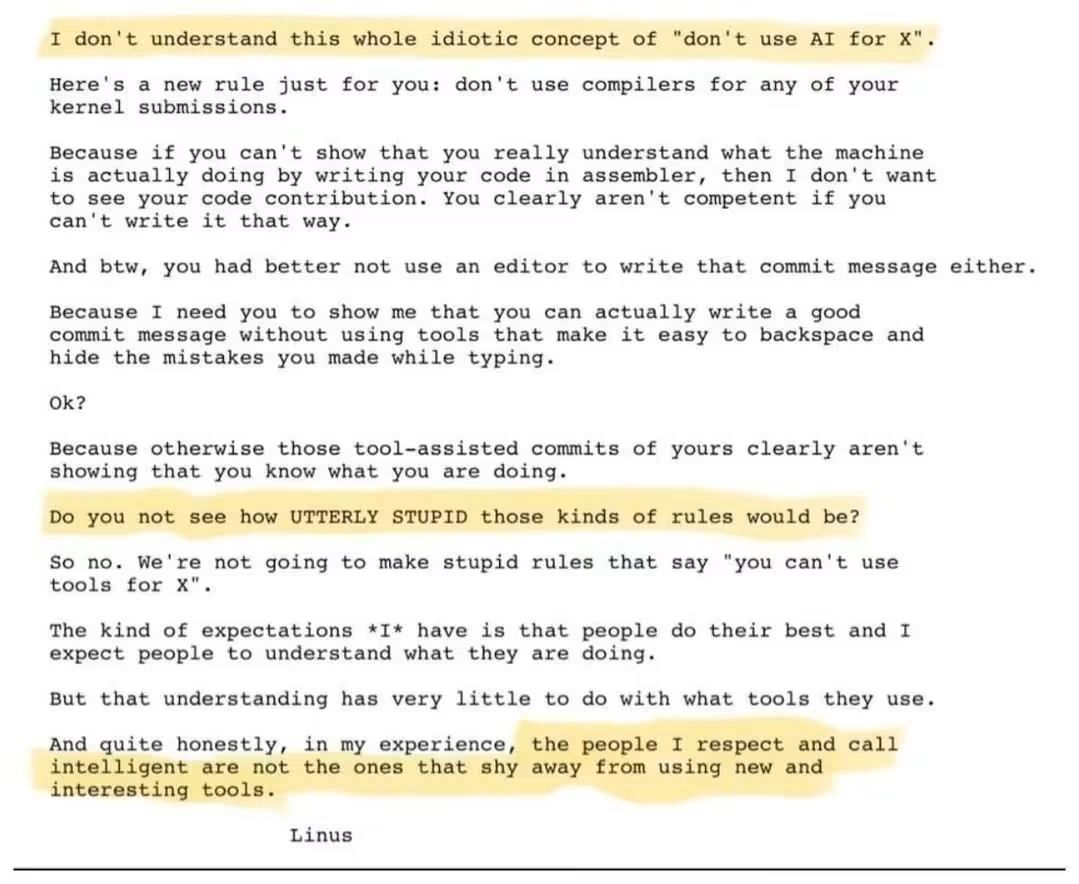
Not even He can be always correct
(and this is a patently idiotic post from him, intentionally missing the point and falling in the classic ad absurdum fallacy)
1 Like
The bad thing is - from my point of view - that this is not only satire, but also a business model that could really work. The effect will not only impair open source, but also careful development of closed source. After a while, nobody will spent any unperceived or unpaid effort, and only slop will remain.
I agree, this post is (mostly) nonsense. Give a clueless person a text editor, and they will achieve nothing. Give them a compiler, and they will still achieve nothing. Give them an IDE with non-AI auto-complete, and they will still achieve nothing. Give them an AI agent, however, and they may produce results that look good at first glance but contain errors and backdoors in one of the most security-critical parts of the software.
AI probably helps an expert, but it also helps someone with little understanding of the underlying technology pass as an expert.
To be fair, I also want to cite an important sentence from this post:
The kind of expectation I have is that people […] understand what they are doing.
Expectation is good, but verifying would be better. AI complicates this.
2 Likes
Are you sure Linus said what is inferred here?
Linux focuses on competent persons, right? So, “give a clueless person” is not what he’s talking about.
Isn’t he talking about another situation? “Give a competent person…”:
- a text editor → they can edit ASM code, better than write without editing
- a compiler → they can write high-level code, more productive than ASM
- an IDE → they can be more productive than with a plain editor+compiler
- an AI agent → they can be more productive, delegating tedious work to AI while keeping control (we are learning how to do this, and some people do it very badly)
Isn’t Linus point that AI can help competent programmers create better code?
Yes, and I see two practical issues:
- An unknown person comes and shows things. Previously, only a somehow competent person could show non-trivial software. Now that AI makes easy for anyone to show things, it’s harder to judge whether the person knew what they were doing.
- Reviewing code is hard and long. Now that AI makes easy to generate lots of code, reviewing capacity has become insufficient, it’s harder to judge whether the code is good.
1 Like
Yes, I agree this probably is his intended point. I guess, he is in a bubble of really competent people and did not even think about that his argument now also covers other, less competent people. The cited sentence (“people [have to] understand what they are doing”) is quite short compared to the elaborated nonsense-examples.
I often heard this argument. I would counter: If programming gets tedious, then there is a flaw in the selection of algorithms, libraries, architecture, or organization. Focus on fixing the root cause, not the symptoms. Else, technical (or other) debt is built up and the same problem will show up over and over again. Sadly, all too often time pressure preserves and worsens problems.
Some of us work in environments where that isn’t possible alas. And often the root causes are well, people (gasp!)