Endlessly fascinated by the quest for the ultimate gameplay—where simple mechanics manage to deliver an immediate, intense, and wildly addictive gaming experience—I set my sights this time on Quantum, an arcade cabinet released by Atari in 1982.
I painstakingly analyzed its mechanics, explored its subtleties, and dissected its gameplay inner workings with a very clear ambition: to port this experience into a new game for the Amstrad CPC, while striving to recapture the original feel… and even bring a few extra touches to the table!
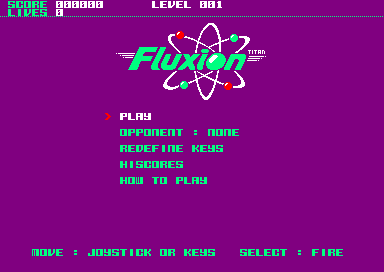
It is from this desire that Fluxion was born, a game in which you have to capture and destroy atoms by encircling them with a tether. A deceptively simple concept that relies on skill, anticipation, and a healthy dose of risk-taking.
Taking full advantage of the machine’s capabilities, Fluxion notably features an Overscan display mode and even offers a simultaneous two-player versus mode, where each player must rely on reflexes and strategy to gain the upper hand.
On the Amstrad CPC 6128, the use of double buffering allows for an exceptionally smooth animation at 50 frames per second. Unfortunately, this performance could not be replicated on the CPC 464, whose more limited memory prevented the implementation of this technique. Nevertheless, the game maintains a solid 25 frames per second on it.
A humble tribute to 80s arcade gaming, revisited with the capabilities and quirks of our beloved Amstrad CPC (and programmed with the help of CLAUDE)!
FLUXION EN (2026).dsk (190.3 KB)
