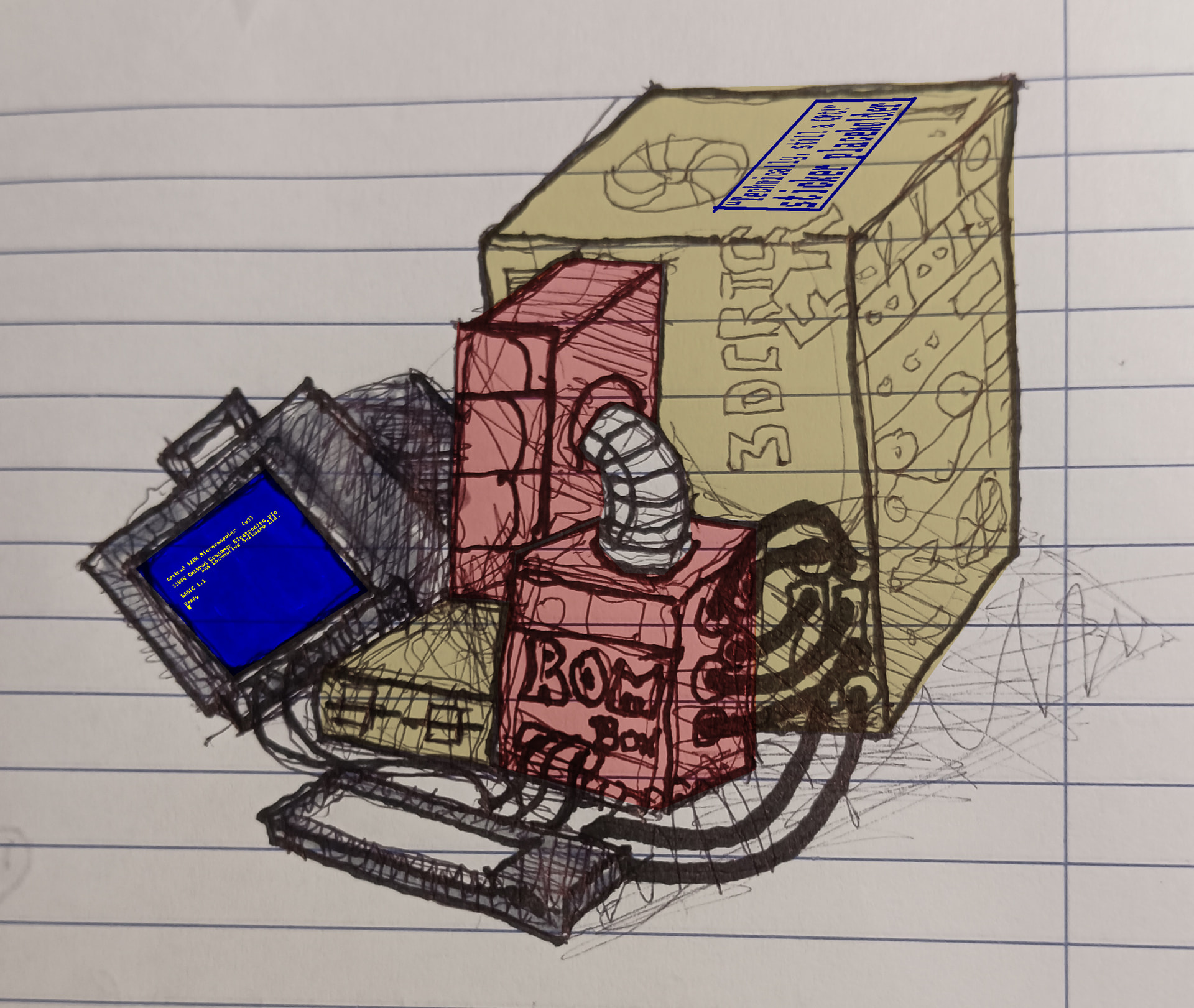
By the mid nineties, the CPC was essentially dead and nobody was going to be buying a game that cost the same kind of prices as top tier MegaDrive or SNES games (which were insanely expensive).
And yes, the CPC hardware design had 8 bits for the ROM slot, but I suspect that was more by accident than design (which mostly just fell out of having 8 bits on the data bus). The 464 firmware expected you’d not need more than 7 and that number was only slightly bumped to 15 in the 664/6128. Nobody really imagined having hundreds of ROMs hung off the back (and I’d expect the machine would encounter electrical stability issues if you did).
What I really mean is: there is one, and only one reason for a cart this big not to be released back then, and that reason is it would have been expensive. In an imaginary world where back then a cart like this would be as cheap as a cassette tape, I’m sure we would have seen plenty big carts. Do we have to restrict the software and hardware designs made today for the CPC by the hardware pricing criteria during the commercial life of the CPC? For me it makes little sense, and it is something I find quite shocking on the CPC community.
I have made plenty designs for the console world and people in the console scene tend to embrace new hardware features (excepting really excessive things I mentioned like those carts running Doom while the console only reads the gamepads). On the Megadrive you have games like Astebros with 16 MiB ROM size and it receives nothing but praise. But here you show a game using 4 MiB ROM that is not possible without this amount of memory and you face criticism
Well, I think it’s fair to say that the design was intended to support that maximum size, since if the engineering results turned out to be different from what was desired, we’d have a serious problem.
It’s a different matter if the firmware engineers, in a given version, decided that it was only necessary to support a fraction of what the hardware supports and then gradually increase it in new versions as needed.
It’s like the 4 GB address limit of 32 bit processors, processor engineers designed it that way, even though MS-DOS never provided native support for 4 GB of RAM.
There’s never going to be a winning argument in a debate like this.
I think it’s more “impressive” to push stock hardware beyond what anyone expects it can do. That’s essentially why some people will be upset about the cart.
I always think the classic computing scene is very much like the classic car scene. Some people love their MGB or Triumph stock and factory restored. Others prefer to drop the engine, update the brakes and gearbox, and stick a Toyota engine in.
Either way, you have a lovely car at the end of it.
Anyone who uses a Gotek for example, doesn’t really have any argument to complain. Double standards… they’ll take the modern conveniences when it suits them (I include myself in this!) whilst turning their noses up at others.
That only tells the designers thought only 15 slot needed to be considered for initialization by the BASIC routines to add RSX commands. In fact adding RSX commands takes some RAM from BASIC so there is a tradeoff there. But that only 15 slots are initialized doesn’t mean you cannot use more for things not having to add these RSX commands.
Maybe you’re right, maybe the designers sat down in 1984 and said it was a key design goal that the hardware needed to support 4MB of ROM. Weird that years later, when designing the Plus machines (that we do have design docs for) they seemed to think 512K was an ample limit for cartridges. But what do I know…
They might not think that 4 MiB needed to be supported. But there’s a fact that the ROM expansion system supports up to 4 MiB. Yes, only 15 slots are initialized by the firmware, but I can switch to slot 163 and read ROM if it’s installed. That works on stock hardware.
Well, I think speculating about whether or not the designers considered whether the limit they set would ever be reached doesn’t get us anywhere. The important thing is that the original hardware supports it, therefore, it’s a feature and capability inherent to the CPC’s design.
In the year 2026, 4Mb of rom is far cheaper and more accessible than a 3" floppy disc.
There was a time when making a game on a large rom would be prohibitively expensive. Now running a game from a genuine floppy disc is prohibitively expensive.
Given that the large majority of AI-assisted games being created require at least 128KB of RAM - even those which look relatively simplistic and ought to run in 64KB - I doubt that current AI models will be able to create a scaled-down version. Who knows what AI will achieve in a few months’ time, though?
Sure. The question was “Could this have been something that would work in a ROMbox in the 80s?” It is hard to argue anything other than “No, not really.”
I don’t think the question was whether it would work in a ROMbox but whether it could have been released as a cartridge. Which it surely could have, if not for the expense.
A bigger problem would be that you would not have had access to a workstation to render the 3d models.
Exactly. As I wrote it was not alien tech, it could have been done and design was not more complex than readily available romboxes at the time, just bigger. It’s just it would have been bloody expensive and a commercial failure. But there’s no technical limitation preventing this to work in the eighties.